For my showreel I wanted to find music that reflected my comic overall, rather than just on a few aspects of it. I wanted it to immerse the potential reader in the feel of the comic. The following words kept coming to mind: natural flow, summer and an overall calm. I had my mind focused on keeping things very light hearted, not devling into rock and roll or something too soft. I tried looking into other shows that were based on the same theme as my comic.
Azumanga Diaoh - OP: Oranges & Lemons
The tune reflected the more silly and comedic nature of the show, with very light-hearted springy sounds and a very inviting tune.
LuckyStar - OP: Motteke! Sailor Fuku
A lot more fast-paced compared to the Azumanga song, many have criticized this opening for being misleading, cause its fast paced and hyper energetic opening does not prepare you in the right mood for the show's more slow paced themes and jokes. That said, many have also stated to this day, they still can't get the song out of their heads.
K-ON! - OP: Cagayake! Girls
A lot more themed around the show, with the primary focus being that all the girls are in a school band/club together. But then again, many have criticized the fact that they feel misled as the show focuses more on the friends, than on the band aspect of their show.
F.R.I.E.N.D.S - OP: I'll be there for you
The theme fits the show perfectly, catching the era in which the show was set, while expressing the main themes of the show, strife with lover, work and money. As well as the companionship of your friends. It also does a very good job of drilling itself into your skull.
After listening to these, I feel like I needed to focus on the single element about my project, that could allow me to cast a wider net. My comic is meant to show that people with physical and mental disabilities or conditions are no different from people who we'd consider normal and that we are all human. So I felt that the best way to go about this was to focus on the one element we all do naturally, waking up. So I felt the best way music for the showreel had of conveying this sense of waking up in the morning was hearing a song on the radio.
Wednesday, 30 April 2014

Tuesday, 15 April 2014


Test Demo one


Issues that occurred-
When using an image as a button, roll over edits the background and not the image itself! Thus we will need to make a custom image that switches out when roll over occurs.
But I am unable to figure out how you insert an image during the processes. Will check tutorials
I forgot how to make scrolling objects.
Images appeared pixelated while editing, but they seem cleaner when working on HTML. it seems might need to fiddle around with how something appears while editing and how it looks when It's actually done, as well as different sizes.
Thursday, 3 April 2014
Treatment of Female Characters in comic books
It's very well known that comic books are a male dominated culture, but females still find their grounds in there, from writers, to artists and even fans. This once male-dominated culture is starting to rub elbows with the opposite sex. And sadly it's not going as smooth as butter.
Females have always seemed to be a hit or miss with the comic book industry, never really sure where their roles stand, or what to do with them. This has caused a very much 'close minded' attitude to women in the industry, both the fans, artists and writers as well as the characters. When it comes to the women who work in business, the male audience seem to treat them like a 'dumb girl' who doesn't understand the business she is involved with, despite probably having written the very comic he's about to read, and that the fans are clueless attention-seeking hogs who know nothing of the source material.
But sadly I do not know much information when it comes to the business side, mostly information and rumours. But as for the actual comic book writers and the characters they ruin, I am a bit more informed.
Example: DC writer Scott Lobdell whom, at the time of me writing, has been outed for his sexist and sexual harassment to a fellow coworker, during a panel.
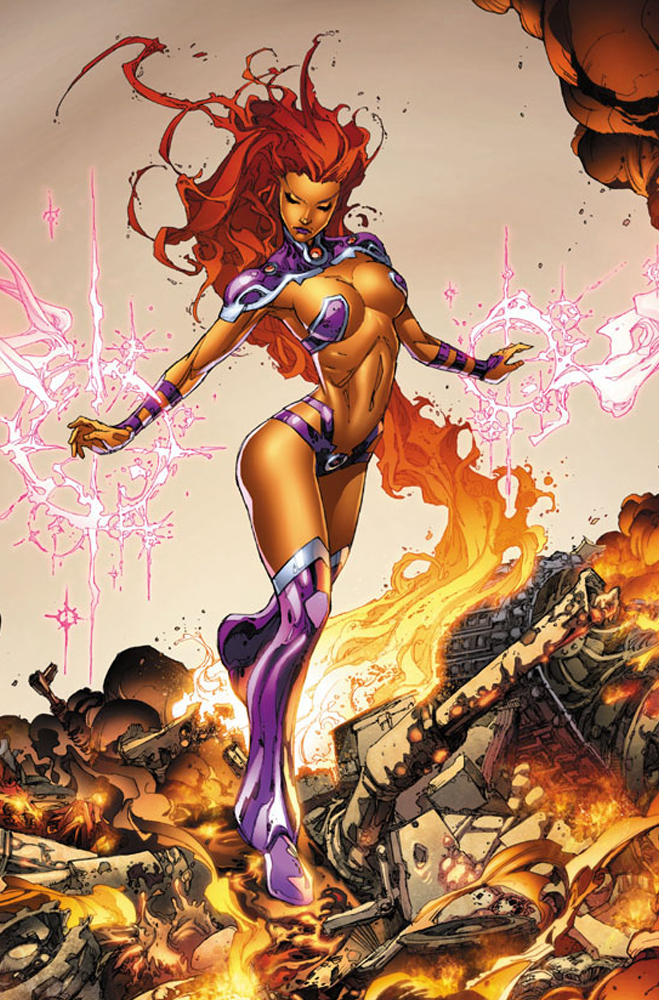
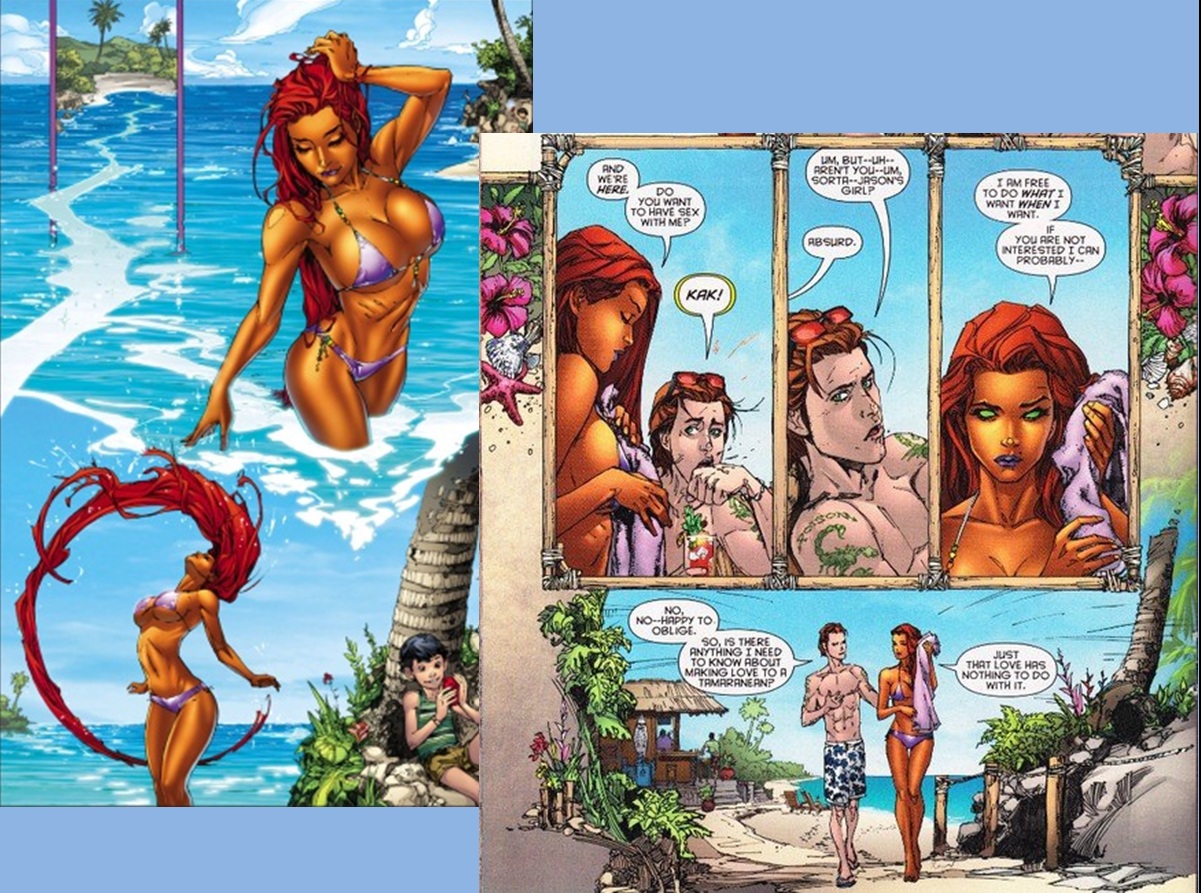
But what could Scott Lobdell have done that's so bad? WELL, one of his 'crimes' against comics is his rendition of Starfire in his book "RedHood and the outlaws."
This was StarFires Original Appearance
This is how Starfire became known by the public
And this is what he turned her into. Exhibit A Exhibit B
To be fair to Scott Lobdell, he isn't the only one to abuse the female character in comic books, it's been going on for a LONG time, way back in the 200th issue of The Avengers.
Released in October of 1980
The comic continued the cliff hanger of the mysterious pregnancy of Ms.Marvel (Known today as Captain Marvel).
In which they revealed that Carol Danvers (Ms.Marvel) was abducted against her will, romanced and led with hypnotic suggestions, so that she could be impregnated with the life essence of her RAPIST, so that she may give birth to him.
Carol only existed in this comic to give birth, because lazy male writers only know this about women.
They like women, women are mothers and women get married. That. Is. It. When it comes to a portion of the comic industry, it is a sad truth, but one we must face.
As such, I choose to follow the teachings of Ridley Scott and create CHARACTERS first and let gender become a second issue only. I do this so I do not fall into the trappings of lesser men before me. Female characters deserve as much respect as their real world counterparts, even more so one could argue. As they are the role models of a new generation, these are the people other people will look towards and read into to see what is right and what is wrong.
Females have always seemed to be a hit or miss with the comic book industry, never really sure where their roles stand, or what to do with them. This has caused a very much 'close minded' attitude to women in the industry, both the fans, artists and writers as well as the characters. When it comes to the women who work in business, the male audience seem to treat them like a 'dumb girl' who doesn't understand the business she is involved with, despite probably having written the very comic he's about to read, and that the fans are clueless attention-seeking hogs who know nothing of the source material.
But sadly I do not know much information when it comes to the business side, mostly information and rumours. But as for the actual comic book writers and the characters they ruin, I am a bit more informed.
Example: DC writer Scott Lobdell whom, at the time of me writing, has been outed for his sexist and sexual harassment to a fellow coworker, during a panel.
But what could Scott Lobdell have done that's so bad? WELL, one of his 'crimes' against comics is his rendition of Starfire in his book "RedHood and the outlaws."
This was StarFires Original Appearance
This is how Starfire became known by the public
And this is what he turned her into. Exhibit A Exhibit B
To be fair to Scott Lobdell, he isn't the only one to abuse the female character in comic books, it's been going on for a LONG time, way back in the 200th issue of The Avengers.
Released in October of 1980
The comic continued the cliff hanger of the mysterious pregnancy of Ms.Marvel (Known today as Captain Marvel).
In which they revealed that Carol Danvers (Ms.Marvel) was abducted against her will, romanced and led with hypnotic suggestions, so that she could be impregnated with the life essence of her RAPIST, so that she may give birth to him.
Carol only existed in this comic to give birth, because lazy male writers only know this about women.
They like women, women are mothers and women get married. That. Is. It. When it comes to a portion of the comic industry, it is a sad truth, but one we must face.
As such, I choose to follow the teachings of Ridley Scott and create CHARACTERS first and let gender become a second issue only. I do this so I do not fall into the trappings of lesser men before me. Female characters deserve as much respect as their real world counterparts, even more so one could argue. As they are the role models of a new generation, these are the people other people will look towards and read into to see what is right and what is wrong.
Tuesday, 1 April 2014


Tuesday, 25 March 2014
Showreel Concepts
For my showreel I'd like to convey the mood and feel of my comic. To help me, I have been looking at showreels by comic book artists online to see if they could help me decide as to what I really want to convey with my comic. While many of them were good, such as Tyson Hesse's (see above) show reel, I didn't feel that they were that helpful to what I wanted.
After much thought, I felt that the best thing to do for my comic's show reel was to put all my cards on the table and truly think what could be the most interesting from what I am able to do.
For this I've decided to show stills of art work that best promote the comic's tone and feel, while having concept art run alongside it to show the production of it.
To help create these stills I've been looking at promotional art for Anime series. such as these.


Tuesday, 11 March 2014
Inspiration & Influences
Anyone who works in any form of creative medium will tell you the importance of research, inspiration and the influences for their work. From the people who inspire us, to the things we search for ourselves, to the little things that come to us every day.
So what influences me?
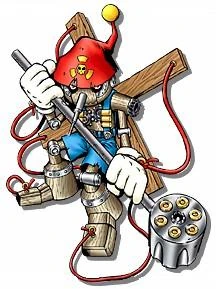
When I was young, anime had just been brought over to the west for kids' TV. Shows like Pokemon, Digimon, Sailor Moon and several others were the highlight of many kids' evenings. Mine included. But it wasn't until near the end of Digimon's series one run time that I actually started drawing. At the time I wanted to draw a favourite Digimon of mine, Puppetmon. My sister was the best artist in our family, along with her friend Liz, but they didn't want to do things for me, so they taught me the basics of how to draw in a somewhat Asian-themed style. Through most of primary school I drew like that.
 This didn't change until I joined a homework club in secondary school, where I was introduced to webcomics by an older student. The first two webcomics I was introduced to were The Wotch and El Goonish Shive, which started me on my comic book binge. I started to read more and more comics, which got me the idea in my head that I should perhaps make my own webcomic. Years followed of me switching styles to a more Western-looking one and many failed attempts at stupid ideas for a comic.
In later years, I started teaching myself to improve, for while I was gradually getting better through sheer force of will and noticing things around me, I didn't actually consider how I could use references and tutorials to teach myself how to be better at comics. This is where I started looking at How to books and tutorials, as well as trying to copy some of the artistic stylings of comics like Comedity.
A few years later leads me to where I am now, learning to inspire myself by not just one or two things, but everything around me. I'm always teaching myself hopefully helpful new techniques and methods to improve my art, as well as asking advice of seasoned artists and friends about my work. I've learned that the greatest asset to an artist or any creative person is critiques and one should not be afraid to try new or different methods to improve oneself.
But this leads to a question that is commonly asked of me...
What inspires me?
To be frank, no one thing in particular. I find that for someone to grow creatively you need to take inspiration from everything, not just something you 'like'. If you're only recreating and replicating from the things you like, then your work will become very bland, stale and VERY predictable. This is why it's good introduce yourself to anything and everything; to experiment.
Even consider things that have been universally panned, because even things that are bad can be done well. It's your job as a creative mind to take what is good and what is bad and to dissect them. What makes it good? What makes it bad? If you removed certain elements would it still be good or bad? Could you make it better?
 One thing you should absolutely do is question everything and always think about the things you are introduced to. Does that mean you can't like anything? You must observe it from a critical mind only? Yes and no, just because you're observing something critically does not mean you can't enjoy it, and just because you enjoy something, doesn't mean you shouldn't observe it critically.
You can actually find new appreciation for both good and bad things when observing them from a new aspect, for example, many people will agree the films done by Ed Wood are TERRIBLE, but new appreciation is found in those films, when you learn of his nothing but pure passion for cinema as an art!

So what influences me?
When I was young, anime had just been brought over to the west for kids' TV. Shows like Pokemon, Digimon, Sailor Moon and several others were the highlight of many kids' evenings. Mine included. But it wasn't until near the end of Digimon's series one run time that I actually started drawing. At the time I wanted to draw a favourite Digimon of mine, Puppetmon. My sister was the best artist in our family, along with her friend Liz, but they didn't want to do things for me, so they taught me the basics of how to draw in a somewhat Asian-themed style. Through most of primary school I drew like that.
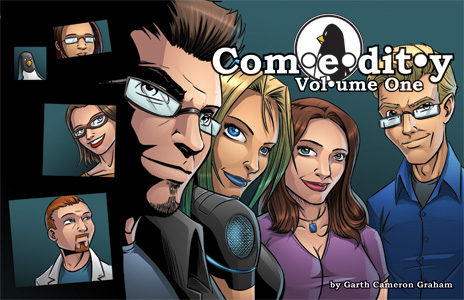
In later years, I started teaching myself to improve, for while I was gradually getting better through sheer force of will and noticing things around me, I didn't actually consider how I could use references and tutorials to teach myself how to be better at comics. This is where I started looking at How to books and tutorials, as well as trying to copy some of the artistic stylings of comics like Comedity.
A few years later leads me to where I am now, learning to inspire myself by not just one or two things, but everything around me. I'm always teaching myself hopefully helpful new techniques and methods to improve my art, as well as asking advice of seasoned artists and friends about my work. I've learned that the greatest asset to an artist or any creative person is critiques and one should not be afraid to try new or different methods to improve oneself.
But this leads to a question that is commonly asked of me...
What inspires me?
To be frank, no one thing in particular. I find that for someone to grow creatively you need to take inspiration from everything, not just something you 'like'. If you're only recreating and replicating from the things you like, then your work will become very bland, stale and VERY predictable. This is why it's good introduce yourself to anything and everything; to experiment.
Even consider things that have been universally panned, because even things that are bad can be done well. It's your job as a creative mind to take what is good and what is bad and to dissect them. What makes it good? What makes it bad? If you removed certain elements would it still be good or bad? Could you make it better?

You can actually find new appreciation for both good and bad things when observing them from a new aspect, for example, many people will agree the films done by Ed Wood are TERRIBLE, but new appreciation is found in those films, when you learn of his nothing but pure passion for cinema as an art!

Thursday, 6 March 2014
Humour in comics
In all forms of media humour plays an important role, for the ability to laugh is a universal thing in all walks of life and deep down I think all humans want to be entertained and smile. This is why humour is implemented into many things, it can make many subjects more relatable and enjoyable once you are able to connect with it. Here are some examples of how different things handle humour differently.
Action/Drama
Many people have heard of the term 'comic relief' while a lot of the times it's used poorly, with characters existing to be purely nothing BUT comic relief. When done right it can add a third dimension to your story and make it more enjoyable. But what is comic relief and how does it apply to the action and drama scene?

This means that the audience has something to ease off the stress from the last scene, which is needed so that the film can build tension again when the climax starts up. Otherwise, if they kept going with the tension, after a while no one would care, their expectations of the scene would drop as they can't climb forever.
Pure comedies
Some things exist to do nothing but shell out laugh after laugh, with silly hijinks and ridiculous leaps of logic, sort of like a Jim Carrey film. But in his films, there is usually some form of drama meant to keep audience seated and not kill them from a busted lung.
One example of this is a comic called One Punch Man, where the entire premise is about a guy who wanted to be a superhero ever since he was a kid. After defeating a man who became a crab monster (after a life time of eating nothing but crabs) he set out to become the greatest superhero. He now has the ability to defeat any opponent with simply one punch, but therein also lies the problem for him. He's bored, he fears nothing, get's excited by nothing and does not enjoy being a superhero at all.

The entire premise of this comic is silly, it's like a child wrote a comic and then a pro artist drew it.
(( Which is already a thing, it's called Axe-cop ))
Because of this, you have to realise that the humour in this particular comic does not come from the whole 'he beats people in one punch', but how the world reacts to him in doing so and his own apathy towards being a superhero who is so powerful. The bit that 'stops the humour' in this comic is not the tension, for there is never ANY tension in this comic, it's when people are talking, or as the comic likes to point out, 'the boring parts'.
Slice of life comedy (and my comic)
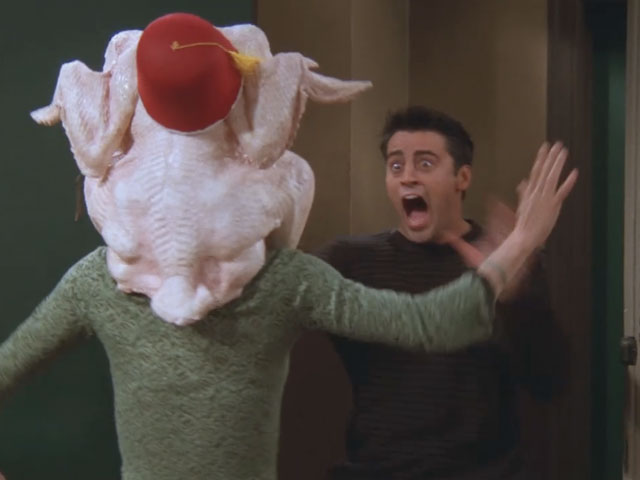
The comedy in these comics generally comes from the everyday life actions of the characters and how the others react to these. The best example of this I can think of for a universal understanding is the sitcom by the name of F.R.I.E.N.D.S. In Friends all the issues, problems, screw ups and everything are nothing extreme, they are everyone's everyday life problems, only made bigger by the characters, because to an average, everyday person, the smallest problem is a major problem as it's 'their' problem.
Tuesday, 11 February 2014
Reflecting on Squash & Stretch and Skullgirls.

We didn't simply do it to talk about our beloved games of course, we realised that we had to focus on our project and seeing as Skullgirls was a 2D, hand drawn, fighting game, we felt there would be MANY examples of squash and stretch taking place.
SADLY, during our presentation, we were met with utter silence from our fellow students. This could easily be due to Skullgirls art style which is very cartoonish but also has a 'fan-service' flare to it with an all female cast with large chest proportions.
Thinking back to it, we should have considered talking about the character's designs, getting the elephant out of the room, but not addressing it in a childish manner. For example.

Painwheel is always crouched or bent over, she walks on all fours and is capable of flight for a short amount of time. This is due to the incredibly heavy metal blade in her back and her weak body frame. While her body does appear toned this is only due to a substance in her body, meant to give her a pained and unnatural look.
This is what helps create her unique move set, balancing her visual style with her fighting style. If you examine her and the other characters move sets in this video, you can see the examples of Squash and Stretch we were trying to get across at the time, especially with Painwheel's muscle inflation and striking abilities as well as her needle attacks.
Wednesday, 29 January 2014
Photographic References
On my walk to a regularly scheduled meeting with my mentor, I felt it be the chance to finally do some photographic references for my comic and studio project. I really wanted to get some photos of Norwich as I personally felt after living here for roughly three years, that it was very much an 'English' city. With its great mixture of old, Middle Aged and new building, it captures a lot of this lovely depressing English bleakness that I feel can only really be appreciated if you've lived in the country.
 How closely do we observe the built environment? Using a camera I started to map the world around me through my lens, hoping to soak up as much of this 'British environment' as best as I could, for I really wanted my comic to capture this feel of England and what makes it this country.
 One aspect of English architecture I was particularly interested in was the nooks and cranny's of building construction and lay out, for it seemed to me that instead of destroying the old, we seem to just stick buildings close together, which creates these lovely (in my opinion) nooks and hideaways for some of the most fantastic locations in the city.
 I find areas like these, one that people would find very unpleasant with the homeless, the graffiti and the constant flooding, to be one of the most important community places in cities like these. Cause every time I go here, it's always different, always changing and always brilliant.
 Buildings like the one on the right and below, are very important as they contain things that are unique to Britain, such as the window tax in 1696. Which caused some home owners to brick up their windows in order to avoid tax, a element that has given some buildings a unique charm.


 Above is a very interesting building I'm constantly coming across on my commute, I find this particular building interesting as it is nothing like anything in the Norwich area. By the looks of it, it seems to be a building that was erected around the 80s to 90s during the business boom. But I wouldn't hold my word to it. To me, it's an old decaying wound that stands solemnly alone amidst the dirt, gravel and dust of a almost empty car park.
A huge part of the 'feel' for my comic, that I hope these pictures will bring, is reality: I want to get the feeling that these people are real, that their lives matter. I want to show the world and town they live in and show that it is one that has been lived, the people who pass by them on the streets have lives, the cars idling the road have owners or have been left to dust. History has happened in this world and as you flick the page you walk the miles the characters walk in their life time. I want people to be drawn into my illusion as much as I am being drawn in researching and making it.
How closely do we observe the built environment? Using a camera I started to map the world around me through my lens, hoping to soak up as much of this 'British environment' as best as I could, for I really wanted my comic to capture this feel of England and what makes it this country.A huge part of the 'feel' for my comic, that I hope these pictures will bring, is reality: I want to get the feeling that these people are real, that their lives matter. I want to show the world and town they live in and show that it is one that has been lived, the people who pass by them on the streets have lives, the cars idling the road have owners or have been left to dust. History has happened in this world and as you flick the page you walk the miles the characters walk in their life time. I want people to be drawn into my illusion as much as I am being drawn in researching and making it.
Saturday, 11 January 2014
The Psychology of Clothing.
I thought it was about time I started studying into the psychology of my characters and the best place to start is grabbing any wiki link I can find, haha. So let's see what we have.
Psychology Today: What your clothes say about you.
Forbes: What your clothes say about you
Life hacker: How your clothes might influence how people see you at work
Psychology Wiki: Clothing
Psychology Today: What your clothes say about you.
Forbes: What your clothes say about you
Life hacker: How your clothes might influence how people see you at work
Psychology Wiki: Clothing
Wednesday, 8 January 2014
Christmas/Birthday and Visual Books
On December the 25th 2013 besides Christmas I also celebrated my 21st birthday and for my birthday I got a numerous amount of birthday presents and while I love each and everyone I found two to be of particular interest to me: the two visual books for Azumanga Diaoh the animation.


These two books give an inside look into the designs needed for the animation and production of the animated Azumanga Diaoh Anime based on the famous Manga of the same name, which was written and illustrated by Kiyohiko Azuma.
Sadly all the books are written in Japanese lettering known as Kanji and thus I am unable to actually read a single word in the book (minus the few actual English words chucked around for no obvious reason). But how exactly would these visual book help me with my work? The answer is in the back of both volumes. And that be 'design references'...


Example, taking in the two characters sheets we can see the top one dresses very sporty but somewhat 'cool', this gives the impression that she herself either views herself to be cool or wants others to view her that way. While the other image, the teacher, dresses very femininely, but from a lot of the expressions used for her on this sheet contradict that feminine feel, this says a lot for how she actually is and how she wants people to see her. But while these are very important factors, one most also consider the characters own comfort and how they feel in these clothes and if they really 'enjoy' what they wear, or if it really is just a guise to how they want people to see them.
Subscribe to:
Posts (Atom)