Tuesday, 25 March 2014

Showreel Concepts


For my showreel I'd like to convey the mood and feel of my comic. To help me, I have been looking at showreels by comic book artists online to see if they could help me decide as to what I really want to convey with my comic. While many of them were good, such as Tyson Hesse's (see above) show reel, I didn't feel that they were that helpful to what I wanted.

After much thought, I felt that the best thing to do for my comic's show reel was to put all my cards on the table and truly think what could be the most interesting from what I am able to do.

For this I've decided to show stills of art work that best promote the comic's tone and feel, while having concept art run alongside it to show the production of it.

To help create these stills I've been looking at promotional art for Anime series. such as these.


Tuesday, 11 March 2014

Inspiration & Influences

Anyone who works in any form of creative medium will tell you the importance of research, inspiration and the influences for their work. From the people who inspire us, to the things we search for ourselves, to the little things that come to us every day.

So what influences me?

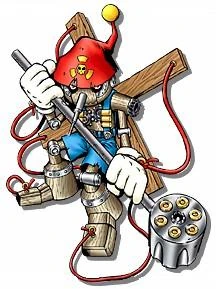
When I was young, anime had just been brought over to the west for kids' TV. Shows like Pokemon, Digimon, Sailor Moon and several others were the highlight of many kids' evenings. Mine included. But it wasn't until near the end of Digimon's series one run time that I actually started drawing. At the time I wanted to draw a favourite Digimon of mine, Puppetmon. My sister was the best artist in our family, along with her friend Liz, but they didn't want to do things for me, so they taught me the basics of how to draw in a somewhat Asian-themed style. Through most of primary school I drew like that.
This didn't change until I joined a homework club in secondary school, where I was introduced to webcomics by an older student. The first two webcomics I was introduced to were The Wotch and El Goonish Shive, which started me on my comic book binge. I started to read more and more comics, which got me the idea in my head that I should perhaps make my own webcomic. Years followed of me switching styles to a more Western-looking one and many failed attempts at stupid ideas for a comic.

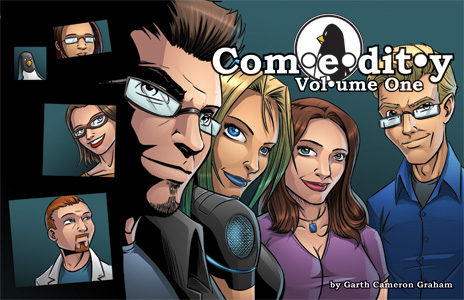
In later years, I started teaching myself to improve, for while I was gradually getting better through sheer force of will and noticing things around me, I didn't actually consider how I could use references and tutorials to teach myself how to be better at comics. This is where I started looking at How to books and tutorials, as well as trying to copy some of the artistic stylings of comics like Comedity.

A few years later leads me to where I am now, learning to inspire myself by not just one or two things, but everything around me. I'm always teaching myself hopefully helpful new techniques and methods to improve my art, as well as asking advice of seasoned artists and friends about my work. I've learned that the greatest asset to an artist or any creative person is critiques and one should not be afraid to try new or different methods to improve oneself.

But this leads to a question that is commonly asked of me...

What inspires me?

To be frank, no one thing in particular. I find that for someone to grow creatively you need to take inspiration from everything, not just something you 'like'. If you're only recreating and replicating from the things you like, then your work will become very bland, stale and VERY predictable. This is why it's good introduce yourself to anything and everything; to experiment.

Even consider things that have been universally panned, because even things that are bad can be done well. It's your job as a creative mind to take what is good and what is bad and to dissect them. What makes it good? What makes it bad? If you removed certain elements would it still be good or bad? Could you make it better?
One thing you should absolutely do is question everything and always think about the things you are introduced to. Does that mean you can't like anything? You must observe it from a critical mind only? Yes and no, just because you're observing something critically does not mean you can't enjoy it, and just because you enjoy something, doesn't mean you shouldn't observe it critically.

You can actually find new appreciation for both good and bad things when observing them from a new aspect, for example, many people will agree the films done by Ed Wood are TERRIBLE, but new appreciation is found in those films, when you learn of his nothing but pure passion for cinema as an art!

Thursday, 6 March 2014

Humour in comics

In all forms of media humour plays an important role, for the ability to laugh is a universal thing in all walks of life and deep down I think all humans want to be entertained and smile. This is why humour is implemented into many things, it can make many subjects more relatable and enjoyable once you are able to connect with it. Here are some examples of how different things handle humour differently.

Action/Drama
Many people have heard of the term 'comic relief' while a lot of the times it's used poorly, with characters existing to be purely nothing BUT comic relief. When done right it can add a third dimension to your story and make it more enjoyable. But what is comic relief and how does it apply to the action and drama scene?
As the name suggests, comic 'relief' is made to lower the stress levels of a scene, to ease tension. Disney is the most common offender when using 'comic relief'. A good example of this is the Lion King, where after Simba's father dies and he is chased from the pride lands, Simba is immediately met by Timon and Pumbaa, who are bright in colour and even have a nice 'don't worry' song.
This means that the audience has something to ease off the stress from the last scene, which is needed so that the film can build tension again when the climax starts up. Otherwise, if they kept going with the tension, after a while no one would care, their expectations of the scene would drop as they can't climb forever.

Pure comedies
Some things exist to do nothing but shell out laugh after laugh, with silly hijinks and ridiculous leaps of logic, sort of like a Jim Carrey film. But in his films, there is usually some form of drama meant to keep audience seated and not kill them from a busted lung.

One example of this is a comic called One Punch Man, where the entire premise is about a guy who wanted to be a superhero ever since he was a kid. After defeating a man who became a crab monster (after a life time of eating nothing but crabs) he set out to become the greatest superhero. He now has the ability to defeat any opponent with simply one punch, but therein also lies the problem for him. He's bored, he fears nothing, get's excited by nothing and does not enjoy being a superhero at all.
To make life harder for him, a cyborg by the name of Geno wants to be his pupil and he's not even a official superhero yet.

The entire premise of this comic is silly, it's like a child wrote a comic and then a pro artist drew it.

(( Which is already a thing, it's called Axe-cop ))

Because of this, you have to realise that the humour in this particular comic does not come from the whole 'he beats people in one punch', but how the world reacts to him in doing so and his own apathy towards being a superhero who is so powerful. The bit that 'stops the humour' in this comic is not the tension, for there is never ANY tension in this comic, it's when people are talking, or as the comic likes to point out, 'the boring parts'.

Slice of life comedy (and my comic)
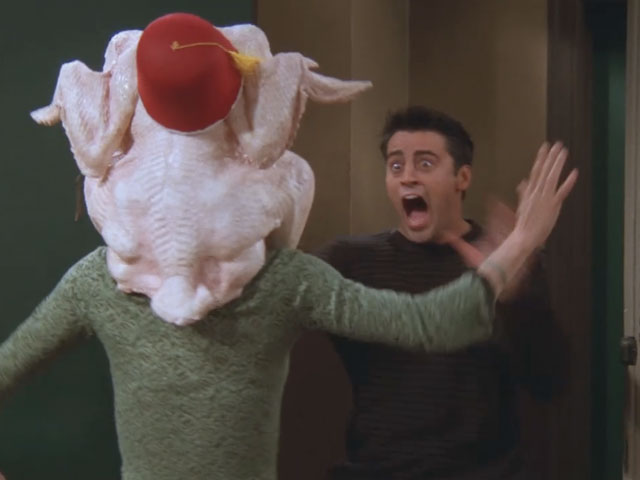
The comedy in these comics generally comes from the everyday life actions of the characters and how the others react to these. The best example of this I can think of for a universal understanding is the sitcom by the name of F.R.I.E.N.D.S. In Friends all the issues, problems, screw ups and everything are nothing extreme, they are everyone's everyday life problems, only made bigger by the characters, because to an average, everyday person, the smallest problem is a major problem as it's 'their' problem.